Creswell, J. W. (1994). Research design: Qualitative and quantitative approaches. Thousand Oaks, CA: Sage Publications. (p. 97-201)
READABILITY OF THE MANUSCRIPT
How quickly and smoothly does the manuscript read? In the preceding-chapters I suggested use of consistent terms, a staging of ideas, and a coherence built into the plan.
- Use consistent terms throughout the manuscript. Stay with the same term each time a variable is mentioned in a quantitative study or a key concept is mentioned in a qualitative study. Refrain from using synonyms for these terms, a problem that causes the reader to work at understanding the meaning of ideas and to monitor subtle shifts in meaning.
- Consider how narrative thoughts of different types guide a reader. This concept was advanced by Tarshis (1982), who recommended that writers stage "thoughts" to guide readers. These were of four types:
Umbrella thoughts. The general or core ideas one is trying to get across.
Big thoughts. Specific ideas or images that fall within the realm of umbrella thoughts and serve to reinforce, clarify, or elaborate on the umbrella thoughts.
Little thoughts. Ideas or images whose chief function is to reinforce big thoughts.
Attention or interest thoughts. Ideas whose purpose is to keep the reader on track, organize ideas, and keep an individual's attention.
Beginning researchers, I believe, struggle most with umbrella thoughts and attention thoughts. A manuscript may include too many umbrella ideas, with the content not sufficiently detailed to support large ideas. A clear mark of this problem is a continual shift of ideas from one major idea to another in a manuscript. Often one will see short paragraphs, almost like those found written by journalists in newspaper articles. Thinking in terms of a detailed narrative to support umbrella ideas may help this problem. Goldberg (1986) not only talks about the power of detail but also illustrates it using the example of the Vietnam veterans memorial in Washington D.C., where names-even middle names-of 50,000 killed American soldiers are listed.
Lack of attention thoughts also derail a good narrative. Readers need road signs to guide them from one major idea to the next. They need to see the overall organization of the ideas through introductory paragraphs and to be told, in a summary, the most salient points they should remember.
- Use coherence to add to the readability of the manuscript. In presenting the topics in this book, I have introduced the components of the research process to present a systematic whole. For example, the repetition of variables in the title, the purpose statement, the research questions, and the review of the literature heading in a quantitative project illustrates this thinking. This approach builds coherence into the study. Further more, by emphasizing a consistent order of variables whenever independent and dependent variables are mentioned in quantitative studies also reinforces this idea.
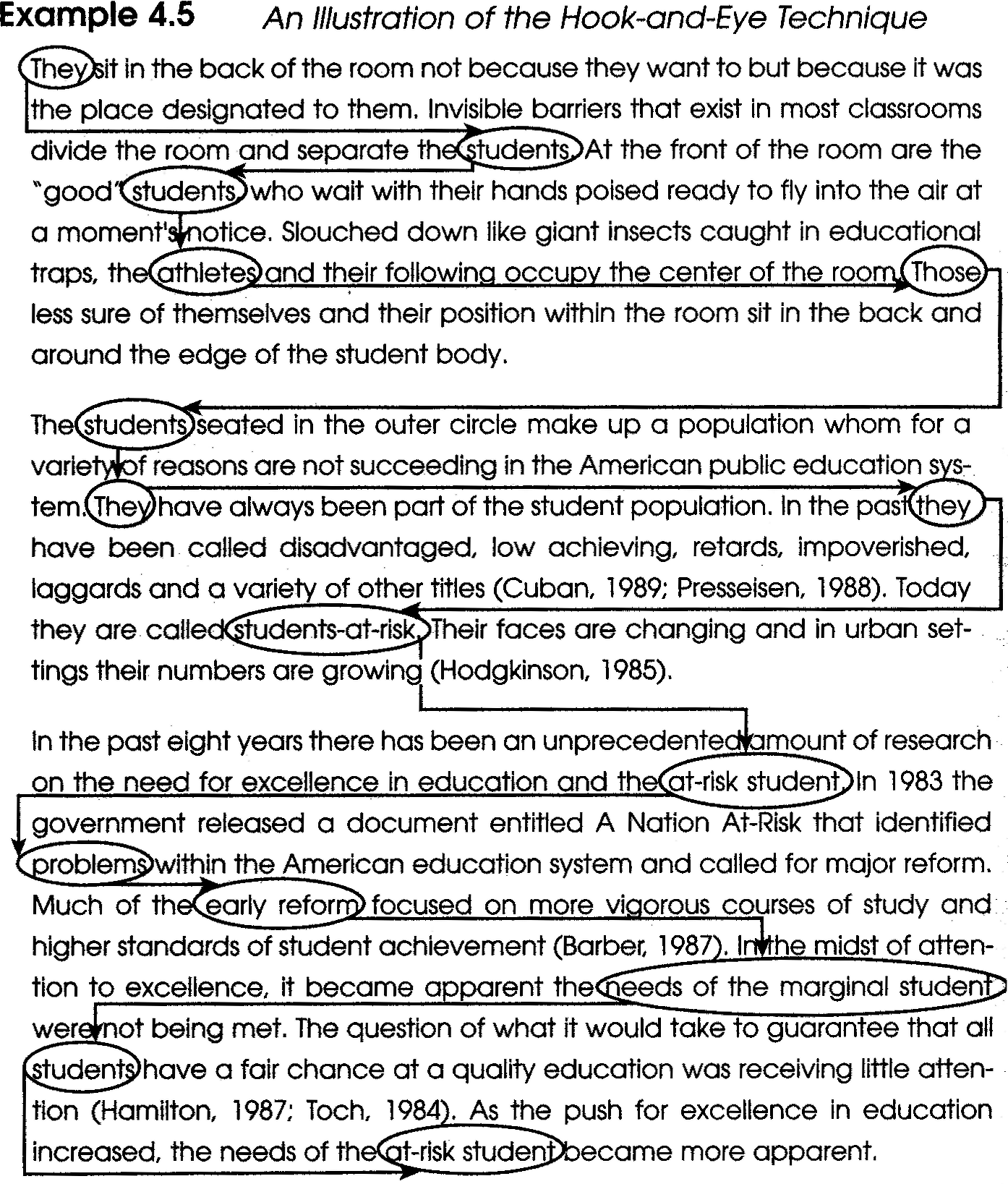
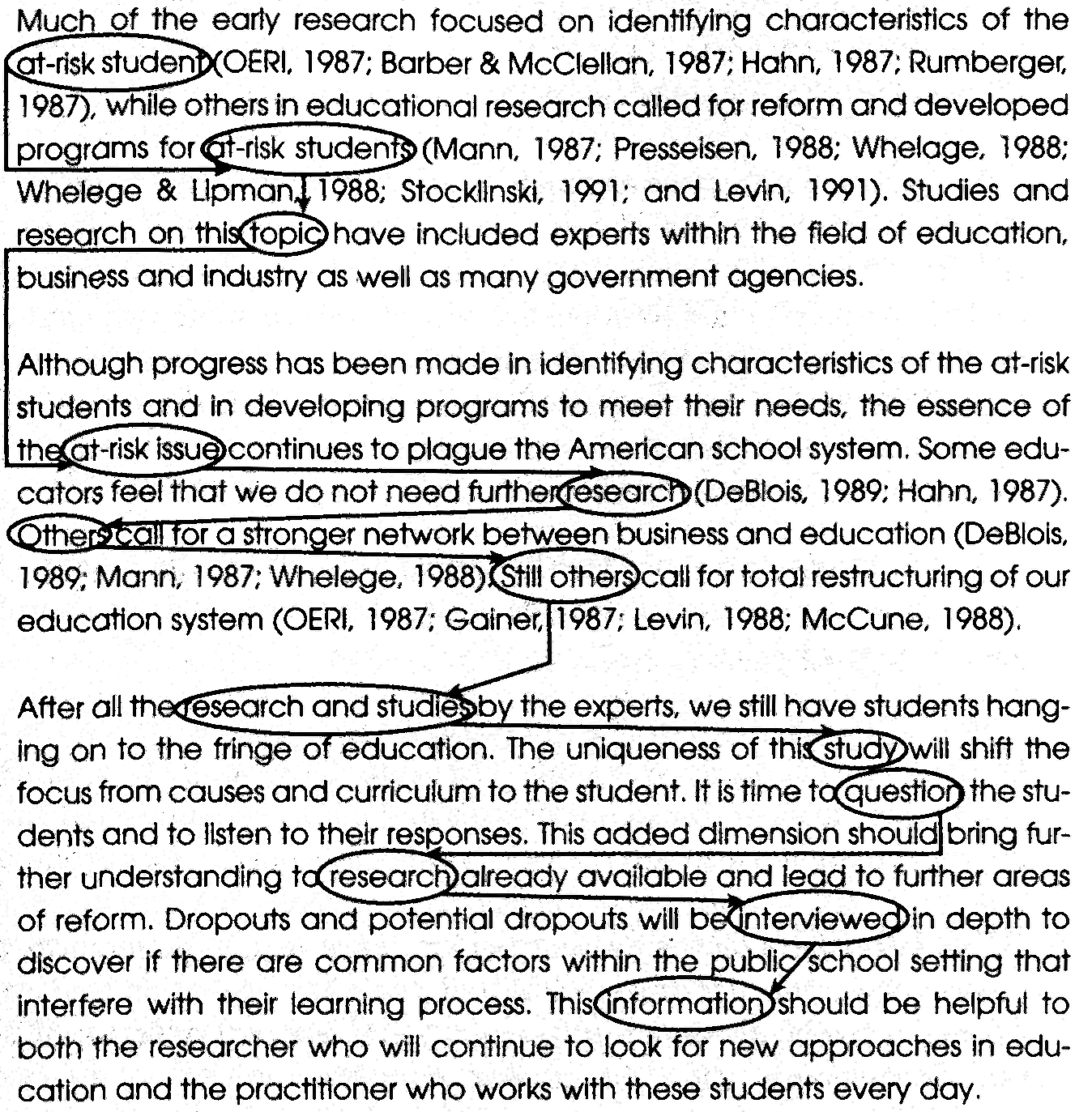
On a more detailed level, coherence builds through connecting sentences and paragraphs in the manuscript. Zinsser (1983) suggests that every sentence should be a logical sequel to the one that preceded it. A useful exercise is the “hook-and-eye” exercise for connecting thoughts from sentence to sentence (or paragraph to paragraph).
The following passage from a draft of a student's dissertation proposal shows a high level of coherence. It is taken from the introductory section to a qualitative dissertation proposal about at-risk students. In this passage I have taken the liberty of drawing hooks and eyes to connect the ideas from sentence to sentence and from paragraph to paragraph. The objective of the hook-and-eye exercise (Wilkinson, 1991) is to connect major thoughts of each sentence. If such a connection cannot be made easily, the written passage lacks coherence and the writer needs to add transitional words, phrases, or sentences to establish a clear connection.